
Guides · Taipa · Verified 22 November 2026
The Taipa Village food walk: one street at a time
Published 22 November 2026
Taipa Village is usually done in twenty hungry minutes on Rua do Cunha. This guide walks it properly, one street at a time: the Cunha gauntlet of pork chop buns, almond cookies and durian ice cream, the quieter lanes behind it where the Portuguese and Macanese kitchens sit, the old market streets, and the two heritage anchors, the Museum of Taipa and Coloane History and the Taipa Houses, that give the eating its context. A grazing route with an order, a rhythm and an evening finish across the water in Cotai.
- The gauntlet
- Rua do Cunha: pork chop buns, almond cookies, durian ice cream and serradura
- The lanes
- Rua Correia da Silva and the old market streets, with the village's Macanese and Portuguese kitchens
- The heritage
- Museum of Taipa and Coloane History, free, 10am to 6pm, closed Mondays; the Taipa Houses, free, 10am to 7pm, closed Mondays
- The finish
- Avenida da Praia and the Church of Our Lady of Carmel, then across the water to Cotai
Taipa Village is the best eating district in Macau, and most people experience it as a single crowded street. Rua do Cunha deserves its fame, but treating it as the whole village is like judging a restaurant by its queue. The old village is a small grid of lanes between the Cotai resorts and the water, and it repays being walked the way it was built: one street at a time, eating as you go, with the heritage buildings read as part of the menu rather than a separate sightseeing duty. This is that walk, in the order to do it, best started in the late afternoon so the last stops land in the evening. Our day trips guide gives the short version; this is the full graze.
Rua do Cunha: the gauntlet
Begin at the famous street and accept the crowd, because the crowd is correct about the food. Rua do Cunha is a narrow pedestrian lane, named for the Portuguese explorer Tristão da Cunha, and its ground floors are given over almost entirely to eating. The canonical sequence runs like this. A pork chop bun first, the village's signature sandwich, a seasoned chop in a crusty roll, eaten standing up while it is hot. Then the bakeries: almond cookies, still made with the moulds and the lard rich crumble that made them Macau's default souvenir, and egg tart rivals to the Coloane original, each shop with its loyalists. Then the sweet cold things that reset the palate: durian ice cream for the committed, coconut and mango for everyone else, and serradura, the sawdust pudding of whipped cream and crushed biscuit that Macanese kitchens adopted as their own. Beef offal stalls, curry fish balls and the rest of the Cantonese street repertoire fill the gaps.
Two disciplines make the gauntlet work. Share everything, because the street is a tasting menu and nobody finishes it solo at full portions. And do not stop at the first branch of any famous name: the lane and its side streets hold the originals and the imitators side by side, and the queues, unusually, are a reliable guide. You will emerge at the far end sweet, salted and ready for the village's quieter register.
The lanes behind: where the village actually eats
Turn off Cunha into the lanes behind it and the tempo drops. This grid, around Rua Correia da Silva and the old market streets, is the working village: the wet market tradition, provision shops, bakeries supplying residents rather than visitors, and the small Cantonese cafes where the day's eating is done without photography. It is also where the sit down Macanese and Portuguese kitchens are found, the restaurants that cook the territory's creole repertoire properly: African chicken with its coconut and spice gravy, minchi, the hand minced meat and potato hash that is Macau's national comfort dish, tacho, the one pot stew that gathers the Portuguese preserved meats into a single Macanese whole, and bacalhau in its dozen local forms. These are lunch and dinner places, not snack stops, and the walk's honest advice is to pick one, sit down, and let it be the meal of the day rather than a footnote to the grazing.
On Rua Correia da Silva, give ten minutes to the building that explains the islands before Cotai existed. The Museum of Taipa and Coloane History, in the former municipal building of the islands, covers the archaeology and community history of Taipa and Coloane, and admission is free. It opens 10am to 6pm with last admission at 5.30pm and closes on Mondays, so on this late afternoon walk it is a first stop rather than a last one; the order in this guide puts it here in the lanes because that is where it stands, but check the hour when you plan your own version.
Largo Camões and Pak Tai: the village square end
The lanes deliver you to the village's older centre of gravity. Pak Tai Temple, dedicated to the Northern Emperor, has watched over Taipa since the nineteenth century and still anchors the local festival calendar, and the streets around it and Largo Camões hold the village's older shophouse fabric, painted, shuttered and increasingly cafe converted, but intact enough to read as a nineteenth century island town. This is the part of the walk to slow down on purpose: a coffee, a bench, and the sight of the Cotai towers rising behind the tiled roofs, which is the single photograph that explains modern Macau better than any other. The village was an island town of farmers, fishermen and fireworks makers within living memory, and its food, part Cantonese village, part Portuguese garrison, part Macanese home cooking, is that history served warm.
The Taipa Houses: the heritage finish
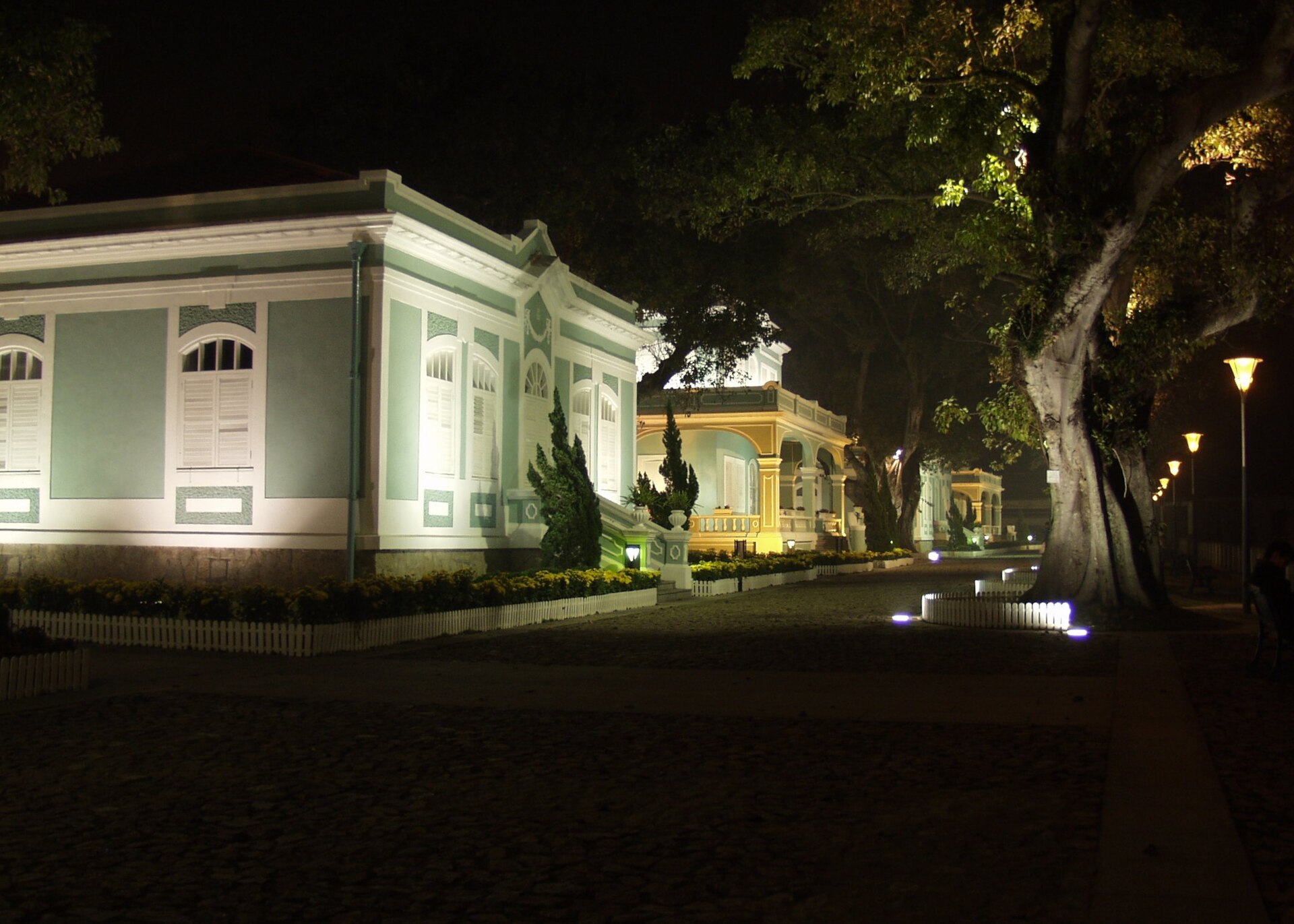
End the walk at its southern edge, on Avenida da Praia, where the five Taipa Houses stand in a mint green row under the banyans, the view in the hero photograph. Built in 1921 as residences for senior officials and Macanese families of the islands administration, they were restored and opened to the public at the end of 1999, and the Cultural Affairs Bureau now runs them as the Taipa Houses: the Macanese Living Museum recreating the furnished interior of a well off Macanese home, exhibition galleries, a creative house and a reception house. Admission is free, the museum spaces open 10am to 7pm with last admission at 6.30pm, and they close on Mondays. Across the road, the whitewashed Church of Our Lady of Carmel, the village's parish church since the nineteenth century, completes the Portuguese island town kit: church, officials' houses, market, temple, food streets. On a Sunday such as this guide's publication day the houses are open, and the early evening, when the day trippers thin and the lights come on along the Praia, is their best hour.
How to run the walk
A few practical rules, learned from the street itself. Start at about 4pm if you want the full sequence in one visit: Cunha at its late afternoon energy, the lanes as the residents come home, the museum and the houses before their evening closures, and the Praia at lighting up time. On a Monday, reverse the heritage order or drop it, because both museums close. Bring small notes and coins, because the smallest and best stalls are not card first businesses, and bring an appetite strategy: the walk fails more often from a full sized lunch beforehand than from any queue. If you are travelling with children, the grazing format is your friend, because nobody has to commit to a whole dish, and the sweet stops can be deployed at exactly the moments morale requires them. And take the side streets seriously even if you eat nothing on them. The village's pleasure is half palate and half texture, the painted shutters, the temple incense drifting across a lane of bakeries, the sudden quiet two turns from the most photographed food street in Macau.
The evening: across the water
The walk's natural second act is ten minutes away. The Cotai resorts sit directly across the old channel from the village, and the contrast, village lanes to resort spectacle, is the whole of Macau in one evening. The Parisian's Eiffel Tower deck is the viewpoint to finish on, with the village you have just eaten through laid out below on one side and the Strip on the other.
And if the grazing somehow left room, the resort dining rooms are the village walk's opposite number, abundance on a different scale; our buffet guide covers the field, and the Studio City buffet is the closest of the majors to the village.
Walk it once this way and Taipa Village stops being a street you visited and becomes a place you understand: a working island town that happens to cook superbly, street by street, in the shadow of the largest concentration of resorts on earth. Start hungry, share everything, and let the last egg tart wait until the houses light up.
Frequently asked
When should you start the Taipa Village food walk?
Start at about 4pm: Rua do Cunha at its late afternoon energy, the lanes as the residents come home, the museum and the houses before their evening closures, and Avenida da Praia at lighting up time.
Are the Taipa Houses free to visit?
Yes. Admission is free, the museum spaces open 10am to 7pm with last admission at 6.30pm, and they close on Mondays.
When is the Museum of Taipa and Coloane History open?
It opens 10am to 6pm with last admission at 5.30pm, admission is free, and it closes on Mondays.
Can you book the food on Rua do Cunha?
No. The village's stalls and bakeries sell over the counter and none is a bookable product, so the walk is a graze: share everything and treat the queues as a guide.
Village details from the Macao Government Tourism Office and the Macao Cultural Affairs Bureau, verified November 2026. Photo: Rene, via Wikimedia Commons (CC BY-SA 4.0), the Taipa Houses on Avenida da Praia at night.