
Guides · Heritage · Checked 16 November 2026
The old town walk: Macau's UNESCO heritage, square by square
Published 16 November 2026
The Historic Centre of Macao is not a museum quarter you tour in a bus. It is a walk, and the order matters. This guide walks it in the order the city built it, from Senado Square north to the Ruins of St Paul's, then south again through Lilau Square to the Mandarin's House, the Moorish Barracks and the A-Ma Temple, explaining what each building actually is, who built it, and what to look at when you are standing in front of it.
- The listing
- The Historic Centre of Macao, on the UNESCO World Heritage List since 2005: 22 buildings and eight squares
- The route
- Senado Square and the Leal Senado, St Dominic's Church, the Ruins of St Paul's, then south to Lilau Square, the Mandarin's House, the Moorish Barracks and the A-Ma Temple
- Distance
- About five kilometres with the return south, mostly flat apart from the St Paul's staircase and the A-Ma hillside
- Cost
- Every stop on the walk is free to enter
- Watch for
- The Mandarin's House closes on Wednesdays except public holidays; St Dominic's Church has had a maintenance programme in 2026, so treat interior access as a bonus on the day
Most visitors do Macau's old town backwards. They rush to the Ruins of St Paul's for the photograph, drift down to Senado Square for shopping, and leave thinking they have seen the UNESCO site. They have seen two postcards. The Historic Centre of Macao, inscribed on the UNESCO World Heritage List in 2005, is a group of 22 buildings and eight squares, and it only makes sense as a route, because the route is the story: a Chinese harbour town at one end, a Portuguese Christian city at the other, and four centuries of the two living side by side between them. Walk it in order and every building explains the next one.
Start: Senado Square and the Leal Senado
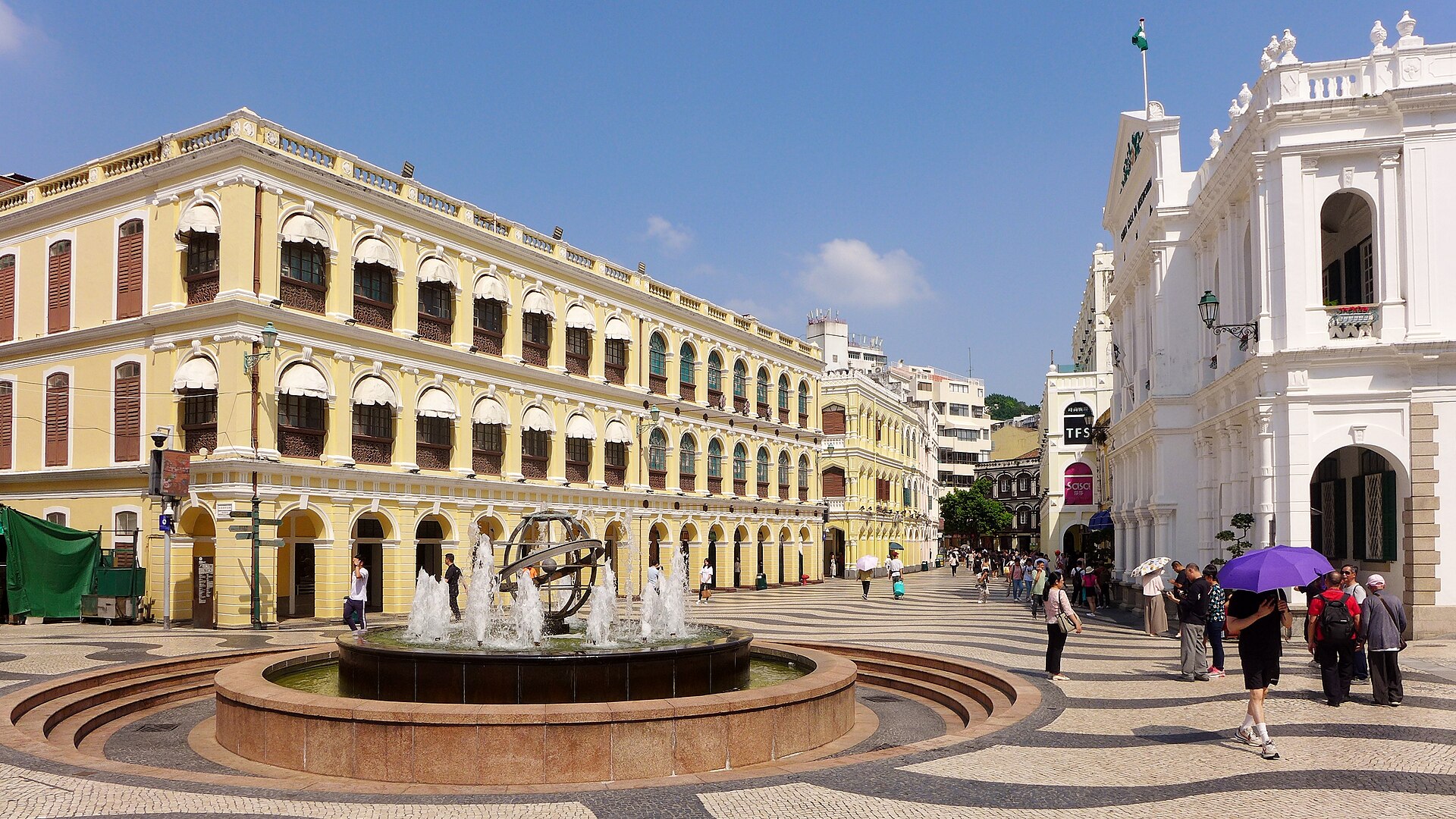
Senado Square, Largo do Senado, is where the walk has to begin, because it was the town's meeting ground for centuries and it is still the centre of the peninsula's public life. Stand by the fountain and read the ground first. The black and white waves under your feet are calcada portuguesa, Portuguese mosaic paving laid in the early 1990s when the square became pedestrian only. The elongated triangular square covers about 3,700 square metres, runs up to St Dominic's Square at one end and Avenida de Almeida Ribeiro at the other, and takes its name from the building facing it.
That white neoclassical building is the Leal Senado, built in 1784 as Macao's first municipal chamber and still the headquarters of the Municipal Affairs Bureau. Leal means loyal, a title granted to the city in the seventeenth century, and the building is a working civic office, not a set piece: go in for the courtyard garden at the back if it is open, because the tiled walls and the quiet are the first surprise of the day. Across the square, the Holy House of Mercy, founded in 1569, ran the city's first Western style clinic and its orphanage. Between chamber, charity and square, you have the whole Portuguese civic idea in one view. Sleep near it if you can: Hotel Lisboa, five minutes east, is the classic old town address.
North: St Dominic's Church
Walk north into St Dominic's Square and the mood changes from civic to religious in about two minutes. St Dominic's Church, yellow facade, white detailing, green shutters, was founded in 1587 by Spanish Dominican priests. It is a working parish church in Baroque style, not a ruin, and that is its point on this walk: where the Ruins show you a facade, St Dominic's shows you a living interior, with a high altar and, in the former bell tower, the Treasure of Sacred Art museum. The church is also where the first Portuguese language newspaper in China was published, in 1822. Normal published hours are 10am to 6pm, free, but the church has had a maintenance programme in 2026, so treat the facade as guaranteed and any interior access as a bonus on the day. Its museum is not the Museum of Sacred Art and Crypt behind the Ruins. They are two different collections.
The top of the hill: the Ruins of St Paul's
Follow the pedestrian lanes north and uphill, past the almond cookie and dried meat shops, and the street delivers you to the bottom of a broad stone staircase of 68 steps. At the top stands the most famous wall in Asia. Be clear about what it is. The Ruins of St Paul's are the granite facade of the Church of Mater Dei, built between 1602 and 1640 by the Jesuits, with Japanese Christian craftsmen among those who carved it, next to St Paul's College, the first Western style university level institution in the Far East. The church and college burned in a fire during a typhoon in 1835. Everything wooden went. The stone front, 25.5 metres high and 23 metres wide in five levels, stayed standing, and Macao chose to keep it as it was.
Read it slowly, from the bottom up. The column orders rise from Ionic to Corinthian and Composite, and the carvings mix the two worlds that built the city: biblical scenes and Jesuit saints alongside Chinese characters, chrysanthemums, a Portuguese ship and stone Chinese guardian lions, including the famous Virgin stepping on a seven headed hydra, labelled in Chinese characters. Behind it, the Museum of Sacred Art and Crypt holds religious artefacts and martyrs' remains. Beside the ruins sits tiny Na Tcha Temple, built in 1888, practically touching the church wall: a Taoist temple and a Jesuit facade sharing a fence is the listing in one frame. Go before 9am if you can. By mid morning the staircase is a crowd scene.
South again: Lilau Square and the Mandarin's House
Now reverse direction and walk south, because the second half of the old town is a different city. Your target is the Barra district, and the hinge is Lilau Square, one of the first Portuguese residential quarters in Macao, a small shaded square built around the spring where residents once drew water. The saying went that whoever drank from Lilau would never forget Macao. It is the calmest square on the walk and the right place to slow down.
A few steps away on Barra Street is the Mandarin's House, the interior of the day. This is a traditional Chinese compound of about 4,000 square metres and more than 60 rooms, built before 1869 for the family of Zheng Guanying, the reform minded writer who completed Words of Warning in Times of Prosperity here. Where every stop so far has been European and public, this one is Chinese and private: gatehouse, courtyards, servants quarters and two enclosed courtyard houses, with moon gates and mother of pearl inlaid shutters worked into a Lingnan plan. Admission is free, 10am to 6pm, last admission 5:30pm, but it closes on Wednesdays except public holidays, so do not build a Wednesday around it. Artyzen Grand Lapa, up by the Outer Harbour, is the peninsula stay that keeps both halves of this walk in easy reach.
The Moorish Barracks: the building that is not a mosque
Continue south along Calcada da Barra and the street produces the walk's strangest building. The long yellow and white block raised on a granite platform, with pointed arches, wide verandas and a crenellated roofline, is the Moorish Barracks, built in 1874 to a design associated with the Italian architect Cassuto. It is not a mosque and it was never a palace. It was built to house an Indian regiment brought from Goa, also then under Portuguese administration, to reinforce Macao's police force, and its Moghul influenced, neoclassical design is what a Goan regiment's home looked like when an Italian designed it for a Portuguese port in China. That sentence is the whole of old Macao in one building. Since 1905 it has been the harbour authority's headquarters and it is now the Marine and Water Bureau, so it is a working government building: the visit is the exterior and the veranda view, which is exactly right for a walk, because this stop is about reading a facade and understanding why it looks like nothing else in the city.
End: the A-Ma Temple, where the city starts
The walk ends where Macao begins. At Barra Square, on the slope of Barra Hill above the Inner Harbour, the A-Ma Temple was already old when the Portuguese arrived. Its Hall of Benevolence is believed to date to 1488, decades before Portuguese administration began in the mid sixteenth century, which makes this the oldest temple in Macao and the one building on the route that predates the encounter the UNESCO listing celebrates. The temple is dedicated to Mazu, goddess of seafarers, also called A-Ma, meaning mother, and the widely told origin of the city's name is that Portuguese sailors asked where they were, were told A-Ma-Gau, the Bay of A-Ma, and heard Macau.
It is a hillside complex, not a single hall: a granite Gate Pavilion guarded by stone lions, a Memorial Arch, a Prayer Hall dating to 1605 and rebuilt in 1629, the Hall of Benevolence, the Hall of Guanyin and a Buddhist pavilion, linked by winding paths, moon gates and carved boulders, with incense coils overhead and several faiths, Confucianism, Taoism, Buddhism and folk belief, worshipped in one compound. It is a living temple, so dress and behave as a guest. Come in the morning if you can, when the light is on the harbour and the worshippers outnumber the tour groups. Ending here, rather than starting here, gives the day its shape: you have walked from the newest paving in Senado Square to the oldest stones in the city.
The evening finish
A heritage day earns a big night, and the honest finish is the one this site recommends for every Macau itinerary: cross to Cotai for the House of Dancing Water at City of Dreams, the reimagined aquatic spectacular that plays Wednesday to Sunday. Old town by day, water theatre by night is the contrast Macao does better than anywhere else in Asia, and booking the show in advance is what turns a good day into a planned one.
The whole walk is about five kilometres with the return south, most of it flat apart from the St Paul's staircase and the A-Ma hillside, and it costs nothing but shoe leather: every stop on it is free to enter. Give it a full day, not a morning, and let the squares set the pace. Get the What's On Macau Note in your inbox on Wednesdays for more walks like this one, square by square.
Frequently asked
Is the Historic Centre walk free?
Yes. Every stop on this route is free to enter: Senado Square, St Dominic's Church, the Ruins of St Paul's facade, the Mandarin's House and the A-Ma Temple, so the whole walk costs nothing but shoe leather.
How long does the walk take?
The full route is about five kilometres with the return south, most of it flat apart from the St Paul's staircase and the A-Ma hillside. Give it a full day, not a morning, and let the squares set the pace.
When is the Mandarin's House closed?
The Mandarin's House is free, open 10am to 6pm with last admission at 5:30pm, but it closes on Wednesdays except public holidays, so do not build a Wednesday around it.
Can you go inside St Dominic's Church?
St Dominic's is a working parish church, normally open 10am to 6pm and free, with the Treasure of Sacred Art museum in the former bell tower. It has had a maintenance programme in 2026, so treat the facade as guaranteed and any interior access as a bonus on the day.
Heritage details from UNESCO, the Macao Cultural Affairs Bureau and the Macao Government Tourism Office, checked November 2026. Photo: Bahnfrend, via Wikimedia Commons (CC BY-SA 4.0), Senado Square and its fountain, with the Holy House of Mercy on the right.