
Guides · Temples · Verified 20 November 2026
Macau's temple trail: incense, sea gods and the old harbour
Published 20 November 2026
Most visitors meet Macau's temples by accident, one incense cloud at a time, on the way between casinos and churches. Walked in the right order, five stops make a trail that explains how Macau actually functioned for four centuries: A-Ma Temple at Barra, where the city gets its name, Kun Iam Tong and its treaty table, the small Na Tcha Temple beside the Ruins of St Paul's, the guild temple of Sam Kai Vui Kun by Senado Square, and the modern Kun Iam statue on the causeway.
- The trail
- Five stops: A-Ma Temple, Kun Iam Tong, Na Tcha Temple, Sam Kai Vui Kun and the Kun Iam Ecumenical Centre
- The oldest stop
- A-Ma Temple, traditionally dated to 1488 and older than the Portuguese settlement itself
- Cost
- Every stop on the trail is free to enter
- Watch for
- Kun Iam Tong closes at 4pm on published listings, and the Kun Iam Ecumenical Centre closes on Fridays
Most visitors meet Macau's temples by accident, one incense cloud at a time, on the way between casinos and churches. That undersells them. The temples are the older half of this city's story, older than the Portuguese churches in one famous case, and they still work for a living: fishermen's families, market traders, examination candidates and grandmothers all burn incense here with specific requests. Walked in the right order, five stops make a trail that explains how Macau actually functioned for four centuries, and it pairs naturally with our UNESCO heritage walk, which covers the same streets from the Portuguese side. This guide takes the Chinese side of the conversation.
Start where the city starts: A-Ma Temple
Every account of Macau begins at Barra Square, and so does this trail. A-Ma Temple, dedicated to Mazu, goddess of seafarers, is traditionally dated to 1488, which makes it older than the Portuguese settlement itself. The Macao Government Tourism Office describes a complex that existed before the city did, and the name of the city is part of the temple's own legend: Portuguese sailors who landed here asked the name of the place and were told A-Ma-Gau, the bay of A-Ma. Whether or not the conversation happened quite that neatly, the geography is real. This was the harbour's edge, and the temple was its spiritual harbour office, the place where crews prayed before sailing and gave thanks after surviving the South China Sea.
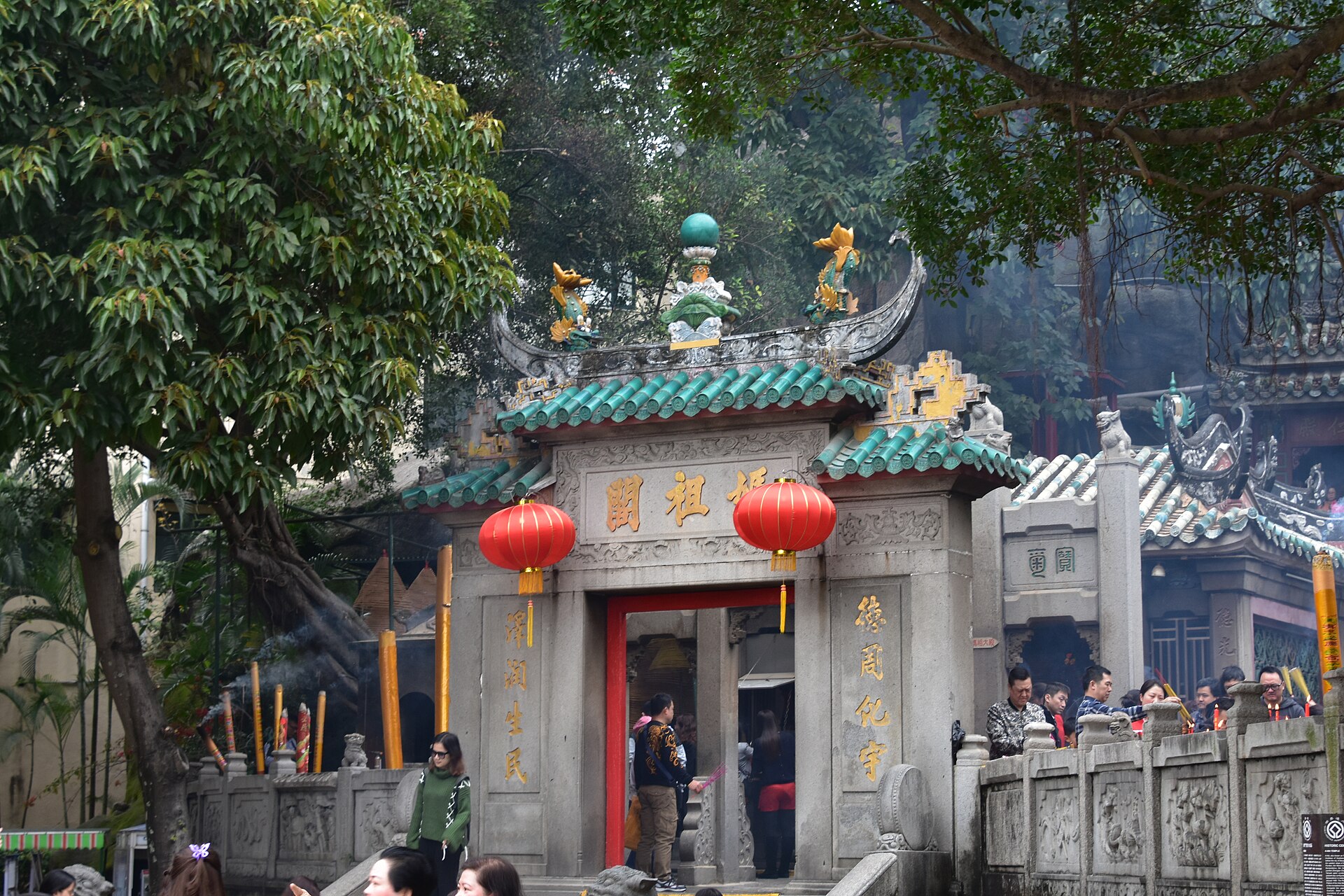
The temple is not one building but a hillside of them, and the order matters. You enter through the stone gate in the hero photograph, pass the Memorial Arch, and climb through a sequence of halls and courtyards cut into Barra Hill: the Prayer Hall, the Hall of Benevolence, the Hall of Guanyin and the Zhengjiao Chanlin, a Buddhist pavilion at the top. Each level changes register, from the busy, smoky, transactional ground floor, where incense coils hang thick and fortune tellers work the corners, to quieter upper terraces where the harbour comes back into view. Give it forty minutes, go early in the morning if you can, and read the rock carvings on the way up, including the famous junk carved into the stone. Entry is free, the published hours run from early morning to 6pm, and this is a working temple, so dress and behave as a guest: shoulders covered, voice down, and no photographs of worshippers at prayer.
The great northern temple: Kun Iam Tong
The second stop is a bus or taxi ride north, and the scale changes completely. Kun Iam Tong, on Avenida do Coronel Mesquita, is one of the three largest and richest Buddhist temples in Macau, dedicated to Kun Iam, the goddess of mercy. Its origins are placed in the thirteenth century and the present buildings carry a patio slab recording construction in 1627. Where A-Ma is a climb, Kun Iam Tong is a procession: a grand entrance gate, then three main pavilions in sequence, dedicated to the Precious Buddhas, the Buddha of Longevity and Kun Iam herself, whose statue wears embroidered silk and a crown and sits flanked by eighteen Buddhas.
The temple's most surprising exhibit is in the garden at the back, and it is a stone table. At that table, on 3 July 1844, the Qing official Keying and the United States minister Caleb Cushing signed the Treaty of Wanghia, the first treaty between China and the United States. It is a useful corrective to the idea that Macau's diplomatic history is only Portuguese. The gardens repay a slow circuit in their own right: terraced plantings, bamboo groves, miniature landscapes, shrines to deceased monks, and the intertwined trees known locally as a symbol of marital fidelity. Published listings put the temple's day at 7am to 4pm, shorter than most visitors expect, so make this a morning or early afternoon stop rather than a late one, and check the current listing before you set out.
Two small temples with large jobs: Na Tcha and Sam Kai Vui Kun
Back in the old town, the trail's third and fourth stops are small enough to miss, and both are doing specific work. The Na Tcha Temple stands immediately beside the Ruins of St Paul's, built in 1888 and rebuilt since, dedicated to Na Tcha, the child deity invoked against plague and misfortune. Its position is the single best illustration of how Macau's two religious worlds actually lived: not in separate districts, but sharing a wall. A Catholic college church, the grandest in Asia in its day, and a folk temple to a Chinese child god, side by side for well over a century, each minding its own congregation. Our free things to do guide covers the practicalities of the surrounding streets.
A short walk south, just off Senado Square, Sam Kai Vui Kun is a different species again: a guild temple, dedicated principally to Kuan Tai, god of war and wealth, and built by and for the Chinese merchant community of the inner harbour. The name refers to the meeting of three streets, and the building doubled as the commercial community's hall, the place where traders settled terms under divine witness. That dual function, temple as chamber of commerce, explains a great deal about how Chinese Macau organised itself alongside the Portuguese municipal world of the Leal Senado a few hundred metres away. It is a quick stop, ten minutes, but it completes the trail's argument: these buildings were infrastructure, not decoration.
The modern coda: Kun Iam on the water
Finish on the Outer Harbour waterfront, where the trail jumps four centuries in one look. The Kun Iam Ecumenical Centre, beneath the bronze statue of Kun Iam that rises from an artificial island in the harbour, is a contemporary space, part exhibition, part quiet room, and free to enter. Our listings record it open 10am to 6pm from Saturday to Thursday and closed on Fridays, with the outdoor grounds open longer. The statue has become one of the territory's defining silhouettes, and seeing it after Kun Iam Tong closes the loop nicely: the same goddess, rendered once in silk and candlelight in 1627 and once in bronze on reclaimed water in the 1990s, still on duty over the harbour.
Walking the trail well
Do the trail in the order given, A-Ma first and early, Kun Iam Tong before its early close, then the two small old town temples as part of an afternoon in the Historic Centre, and the Ecumenical Centre at the end of the day when the light is on the water. Temples are free throughout, which makes this one of the cheapest full days in Macau, but free does not mean casual. Buy incense if you want to participate, light it at the outdoor burners, and bow with it held at forehead height, or simply stand back and watch, which nobody minds. Avoid the first and fifteenth days of the lunar month and the big festival days, above all the birthday of A-Ma in the third lunar month, unless crowds and ceremony are the point of your visit, in which case they are magnificent and you should go early and surrender to them.
If you would rather have the old town's two religious worlds explained together, on the ground, the private heritage tour this site already carries walks the temples and churches as one story, with hotel pickup.
And the open top bus, which loops the peninsula's sights including the temple districts, is the low effort way to string the stops together on a hot day.
Macau's churches get the postcards, and our churches trail gives them their due later this week. But the temples were here first, they served the people who actually sailed, fished, traded and buried their dead in this harbour, and they are still serving them. Walk the trail and the rest of the city, casinos included, makes a different kind of sense. Get the What's On Macau Note in your inbox on Wednesdays for more walks like this one, temple by temple.
Frequently asked
Are Macau's temples free to enter?
Yes. Every stop on this trail is free to enter: A-Ma Temple, Kun Iam Tong, Na Tcha Temple, Sam Kai Vui Kun and the Kun Iam Ecumenical Centre, so the whole trail costs nothing but shoe leather and the bus fares between stops.
What are Kun Iam Tong's opening hours?
Published listings put the temple's day at 7am to 4pm, shorter than most visitors expect, so make it a morning or early afternoon stop rather than a late one, and check the current listing before you set out.
When is the Kun Iam Ecumenical Centre closed?
The centre is free to enter, open 10am to 6pm from Saturday to Thursday and closed on Fridays, with the outdoor grounds open longer.
When is A-Ma Temple busiest?
Avoid the first and fifteenth days of the lunar month and the big festival days, above all the birthday of A-Ma in the third lunar month, unless crowds and ceremony are the point of your visit. Go early in the morning for the quietest visit.
Temple details from the Macao Government Tourism Office and the Macao Cultural Affairs Bureau, verified November 2026. Photo: Richard Mortel, via Wikimedia Commons (CC BY 2.0), the stone gate of A-Ma Temple at Barra Square.