
Guides · Views · Checked 16 November 2026
Macau from above: the viewpoints guide
Published 16 November 2026
Macau is a low city with three hills, one very tall tower and a handful of decks, and each height shows you a different town. This guide ranks the viewpoints by what they actually reveal: Macau Tower for the whole territory in one turn, Guia Hill for the old peninsula and its lighthouse, Penha Hill for the harbour and the tower itself, Mount Fortress for the rooftops around the Ruins, Taipa Grande and Alto de Coloane for the islands, and the Parisian's Eiffel Tower deck for Cotai at night.
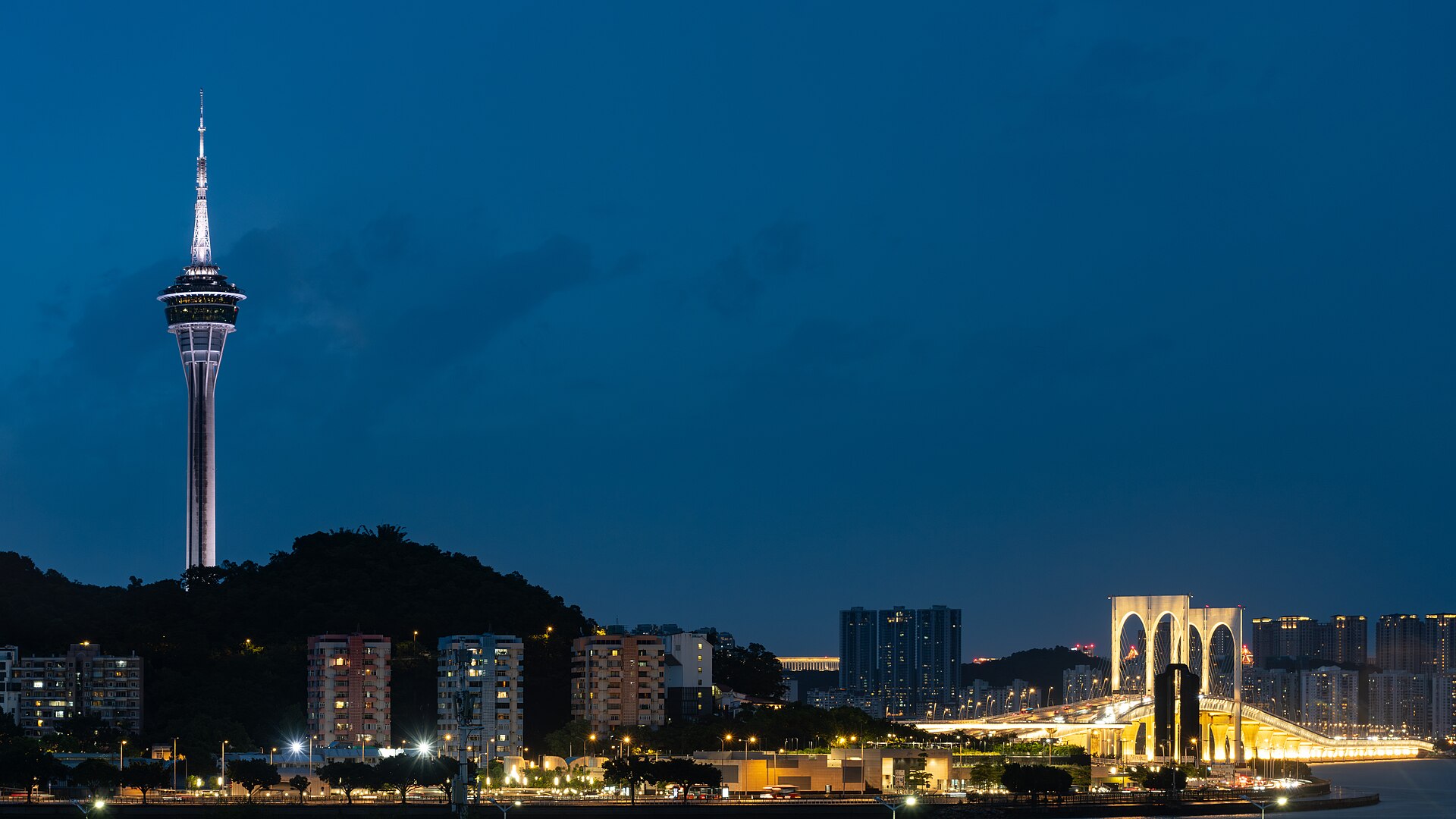
- The tall one
- Macau Tower, 338 metres: the Level 58 Observation Lounge at 223 metres and the Level 61 Adventure Deck above it
- The high ground
- Alto de Coloane at 170.6 metres is the highest point in Macau; Taipa Grande is 158.2 metres; Guia Hill, at about 90 metres, is the highest point on the peninsula
- Free viewpoints
- Guia Fortress and lighthouse, the Mount Fortress platform, Penha Hill, Taipa Grande and Alto de Coloane
- Paid decks
- Macau Tower, and the Eiffel Tower at The Parisian Macao, with observation decks on the 7th and 37th floors
Macau rewards height, but not all height is equal. This is a small, dense, mostly low rise territory built around water, so a modest hill can open up the whole story, while the tallest structure in town shows you something else entirely: reclamation, bridges and three islands stitched into one city. The trick is knowing which viewpoint answers which question. Understand the old town, photograph the tower, watch planes land, or see Cotai light up? Each place below is good for one of those jobs and ordinary for the others.
The full picture: Macau Tower
Macau Tower is the viewpoint everything else is measured against, because it is not really a viewpoint in the city. It is a viewpoint above it. The tower stands 338 metres tall on the Nam Van waterfront, opened on 19 December 2001, and was designed by New Zealand architect Gordon Moller on the model of Auckland's Sky Tower. The ticket covers two levels: the Level 58 Observation Lounge, a 223 metre indoor deck wrapped in three storey glass, and the Level 61 Adventure Deck above it, open air. On a clear day the 360 degree turn takes in the whole peninsula, Taipa, Coloane, the bridges, Zhuhai and Hengqin, and, as the operator likes to remind visitors, a glimpse toward Hong Kong. On a hazy day it is still the best orientation device in Macau: do it on your first morning and every street below makes more sense afterwards. Published observation hours are currently 10am to 8pm. Sunset is the prize slot, so book ahead for weekends.
Level 61 is also where Macau stops being scenic and starts being a dare. The adventure platform sits at 233 metres. The Bungy Jump from the outer rim holds the Guinness record as the highest commercial bungy jump from a building, the Skyjump is a fast, tethered, feet first descent, and the Tower Climb goes up the mast itself. Between them sits the Skywalk, a harnessed walk around the outside rim on a walkway 1.8 metres wide with no handrail, clipped to an overhead rail, lasting about 15 to 20 minutes. It is the one to choose if you want the exposed view without the fall: your friends can watch from the glass inside, and the package includes the tower admission, so it replaces the plain ticket rather than adding to it. The tower's own 360 Cafe, the revolving restaurant, is the sit down version of the same view and the only rooftop table in this guide we name without hesitation, because it is the tower's own, long established and verifiable.
The old town from its own hill: Guia Fortress and lighthouse
Guia Hill is the opposite experience: lower, older and free. At about 90 metres it is the highest point on the Macau Peninsula, and on its summit sits Guia Fortress, built between 1622 and 1638, the second zone of the UNESCO Historic Centre listing. Inside the walls stand the Chapel of Our Lady of Guia, dating to around 1622 and known for frescoes rediscovered in 1996 that mix Western and Chinese motifs, and Guia Lighthouse, completed in 1864 and first lit on 24 September 1865, 15 metres or so of white tower that was the first modern lighthouse on the China coast and is still an active aid to navigation. The lighthouse interior is not open to the public, apart from rare announced special openings, so the visit is the exterior, the chapel and the ramparts. The fortress opens daily 9am to 6pm, with no admission after 5:30pm, the chapel 10am to 5pm, and admission to both is free.
What you get for the climb is the peninsula read as a map: the dense old town below, the Outer Harbour, the bridges to Taipa and the mainland hills beyond. Come in the morning, when the light is on the lighthouse. The Guia Cable Car from Flora Garden makes the ascent in about a minute and a half for a few patacas, runs Tuesday to Sunday, 8am to 6pm, and closes on Mondays, when the walking paths through Guia Hill Municipal Park become the point of the place anyway.
The harbour view and the tower photograph: Penha Hill
If Guia is where you look at the old town, Penha Hill is where you look at everything Guia cannot show you, including the tower itself. Penha Hill, also called Bishop's Hill, rises 62.7 metres in the southwest of the peninsula, the third highest hill in Macau, and its summit holds the Chapel of Our Lady of Penha. The first chapel here was built in 1622 by sailors who had vowed it after escaping Dutch pursuit, which made it a place of pilgrimage for seafarers, and the present church, rebuilt in the nineteenth century, stands beside the Bishop's Palace of 1935. The resident community lists chapel visits in the daytime and the forecourt and grotto open into the early evening, and in practice it is the forecourt you come for.
From that terrace the view runs across Praia Grande and Sai Van Lake to Macau Tower, the Sai Van Bridge and Taipa beyond, with the Inner Harbour on the other side. It is the classic postcard angle on the tower, the quietest of the peninsula viewpoints, and the best sunset warm up in the city: locals, couples, almost no tour groups. The walk up through the residential streets from the Barra side is steep and short. Pair it with the A-Ma Temple and the Mandarin's House at the foot of the same district and a Penha afternoon becomes the southern half of the old town done properly, finished from above.
The free rooftop in the middle of town: Mount Fortress
Every visitor walks past Macau's easiest viewpoint without climbing it. Mount Fortress, the 1620s Jesuit fort directly beside the Ruins of St Paul's, was built between 1617 and 1626 on a 52 metre hill, helped repel the Dutch attack of 1622, and now holds the Macau Museum inside its walls. The grassed platform on top, with its old cannon, is a free, open panorama over the rooftops of the historic centre, the Grand Lisboa rising to one side and the dense residential blocks of the peninsula to the other. It is not high enough to compete with Guia or the tower, and it does not try to be. It is the viewpoint that explains the street you have just walked, five minutes after you walked it, and on a first day in the old town it is worth more than either of the bigger climbs. Go straight up after the Ruins, before the museum, while the geography is still fresh.
The islands from their own high ground: Taipa Grande and Alto de Coloane
South of the bridges, the viewpoints change character. Taipa Grande, Big Taipa Hill, is Taipa's highest point at 158.2 metres, with a viewing platform reached by road and an inclined lift, known locally for sunrise, sunset and watching aircraft at Macau International Airport below. The view back across Cotai makes the territory's shape click: three land masses and the reclaimed strip that joined two of them. Further south, Alto de Coloane at 170.6 metres is the highest point in all of Macau, a green summit above Coloane's country park trails, near the A-Ma Cultural Village and its 19.99 metre statue of A-Ma, the height chosen to mark 1999, the year of the handover. The Coloane Trail runs about 8.1 kilometres, and even a shortened version gives you the rarest view in Macau, Macau with almost no buildings in it: Hac Sa Beach below, the South China Sea beyond, Cotai's towers far away on the northern horizon. These are half day trips, not photo stops.
Cotai after dark: the Parisian's Eiffel Tower deck
Cotai has no hills, so it built one. The Eiffel Tower at The Parisian Macao is a half scale replica of the Paris original, and its observation decks on the 7th and 37th floors are the Strip's own viewpoint: the 7th floor for the resort architecture and gardens at close range, the 37th for a full panorama of Cotai's towers lit for the night. It is a manufactured view and it knows it, and after dark, with the tower's own light show running through the evening, it is also a genuinely enjoyable one. Book the deck ticket ahead at peak times rather than queueing at the counter.
Stay on the Strip and the deck is a pre dinner stroll. The Parisian itself is the natural base for a viewpoints trip that leans south, Cotai for the nights and the peninsula hills for the days.
How to choose, and where to sleep for the views
Short version. One viewpoint only, and you want to understand Macau: Macau Tower, in the morning, on day one. One viewpoint only, and you want the photograph: Penha Hill at sunset, with the tower in front of you rather than under you. History first: Guia in the morning and Mount Fortress on the same day as the Ruins. A full day out of the city: Coloane, with Taipa Grande on the way back. And if your hotel is part of the view, base on the peninsula for the hills. Hotel Lisboa stands in the middle of the old peninsula panorama, minutes from Penha and Mount Fortress and a short ride from Guia and the tower, which makes it the sleep that serves four of the six viewpoints in this guide.
Whichever heights you choose, do one of them twice, once in daylight and once after dark. Macau is two cities, and only the viewpoints show you both. Get the What's On Macau Note in your inbox on Wednesdays for more guides that rank the city by what it actually shows you.
Frequently asked
What is the best viewpoint in Macau?
It depends on the job. Macau Tower, in the morning on day one, if you want to understand the whole territory in one turn. Penha Hill at sunset if you want the photograph, with the tower in front of you rather than under you. Guia and Mount Fortress for history, and Coloane for a full day out of the city.
Which Macau viewpoints are free?
Guia Fortress and its lighthouse grounds, the grassed platform on top of Mount Fortress, Penha Hill, Taipa Grande and Alto de Coloane are all free. The paid decks are Macau Tower and the Eiffel Tower at The Parisian Macao.
How high is Macau Tower?
The tower stands 338 metres tall. The ticket covers the Level 58 Observation Lounge, a 223 metre indoor deck, and the Level 61 Adventure Deck above it, with the adventure platform at 233 metres.
What is the highest point in Macau?
Alto de Coloane, at 170.6 metres, above Coloane's country park trails. Taipa Grande, at 158.2 metres, is Taipa's highest point, and Guia Hill, at about 90 metres, is the highest point on the Macau Peninsula.
Viewpoint details from the Macao Government Tourism Office, the Macao Yearbook and the Cultural Affairs Bureau, checked November 2026. Photo: Jayden Chao, via Wikimedia Commons (CC BY-SA 4.0), Macau Tower and the Sai Van Bridge at blue hour.